🏛️ Lieu
Patrimoine & Culture
Piney
📍 Piney, Aube
· Rue Louis Husson, 10220 Piney
À propos
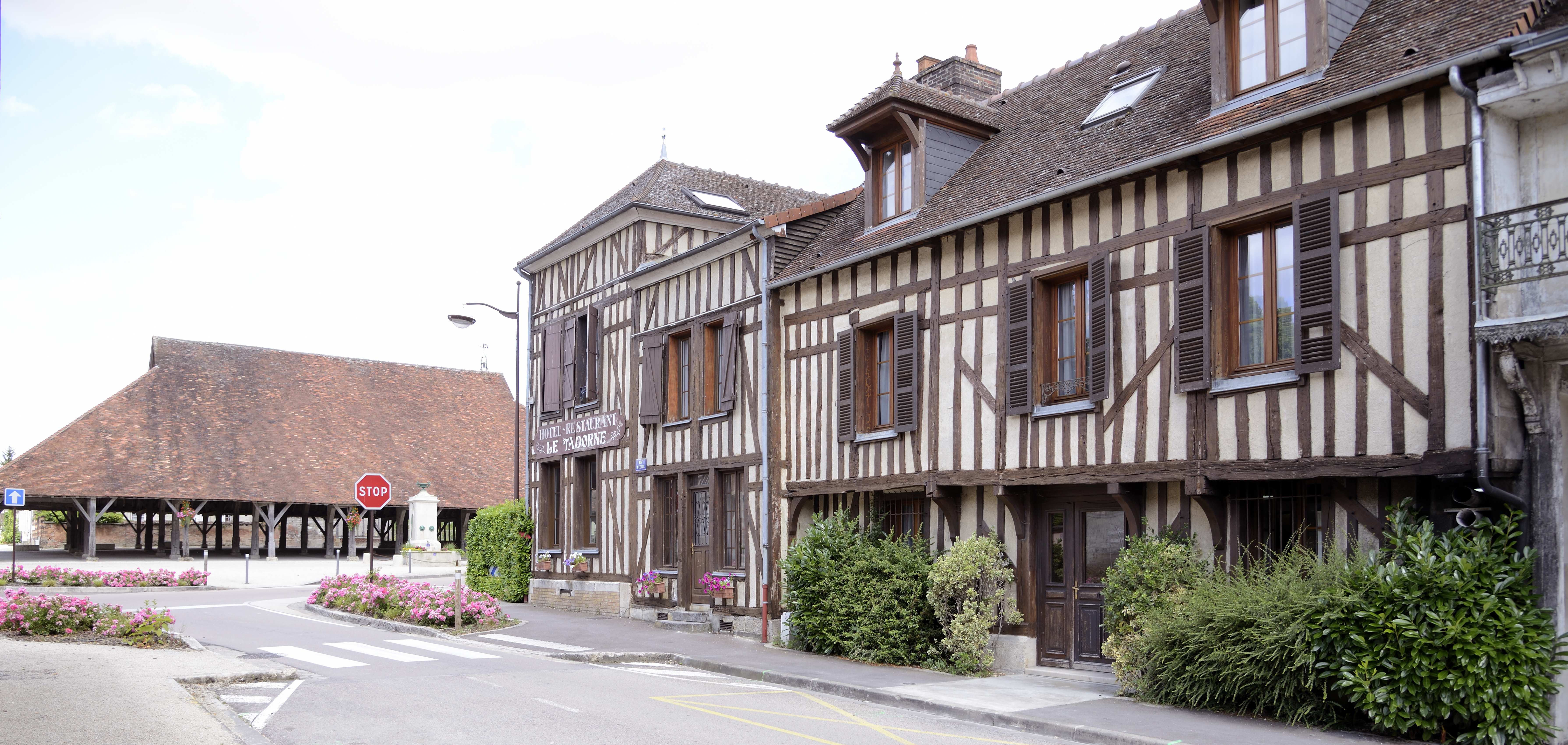
Piney is derived from the name pisiniacus, composed of Pisini, a Latin man's name, and the Gallic suffix Ac, marking place names. It was therefore a Gallo-Roman estate owned by Pisinus, who settled here between the 1st and 4th centuries, near the Troyes-Naix-les-Forges Roman road, known as the Chemins des Romains. This ancient road forms the boundary with the neighboring commune of Onjon. The market is held here on Tuesdays. A little geography: Municipality of Piney + hamlets of Rachisy, Brantigny, Villevoque and Villiers-le-Brûlé 562 inhabitants in 1790 - 1252 inhabitants in 1999 Inhabitants' name: les "Pinois" 7098 hectares in surface area Wet agricultural region: Champagne humide et crayeuse Geographical region: State forests of Champagne humide et crayeuse. A little history: Before the French Revolution, the commune was called Piney-Luxembourg in honor of the local lords, the Luxembourgs. After the 1st World War, the French Post Office (PTT) suggested giving additional names to many communes to avoid confusion. Piney asked for the name Piney-Luxembourg, but was refused for fear that mail would be routed to the Grand Duchy. A belated revenge, the commune adopted the arms of Luxembourg, surrounding them with a golden border charged with eight cinquefoils gules, symbolizing the Forêt d'Orient, divided in the 16th century into two parts, the Orient of Brienne and the Orient of Piney. Piney's territory once boasted numerous vineyards in the localities of "les Grandes Treilles", "les Vignes de Villiers" and "les Plants" There were two rope factories in Piney, those of M. Guyot and M. Clément, who made ropes from lime bark fibers until the mid-19th century. The buildings still stand. Cultural heritage: Saint-Martin church, built in the 16th century and rebuilt between 1877 and 1881 in a style close to the 16th. The rebuilt part is clearly distinguishable from the old church. It is rectangular in plan, with a five-sided apse. The nave has four bays and as many aisles. The stained glass windows also date from the 16th century. Their theme is "Creation". One of them, worthy of the excessive neo-Gothic style of the last century, stands out for the richness of its decoration. Finally, there's the painting of the vows of the Duchess and Duke of Piney-Luxembourg, as high as a cinema screen. Chapelle Notre-Dame-des-Ormes, early 16th century. It was built in place of a ruined chapel. It has a square floor plan with a three-sided apse. The entrance door is flanked by two small square windows at man-height, allowing pilgrims to look in and encourage prayer and almsgiving. In the past, it was the site of a pilgrimage to honor Notre-Dame-de-Pitié, whose main feast took place at the end of August. Halle de Piney: this was not originally a seigneurial hall, but a fair and market hall. It was apparently put up for sale as national property when the Luxembourg estates were confiscated during the French Revolution. As the commune was not rich enough to buy it back, it encouraged Louis-Charles Loyez to do so. He wanted to sell it to the commune in 1813, but the time was not propitious, as all the communes in France were selling their property in the wake of the disastrous Russian campaign of 1812, in order to provide for the formation of a new army. He repeated the proposal in 1817, but the commune was still unable to pay. Finally, in 1821, the commune acquired the hall for 4,000 francs, from Pierre Lesterp. In 1843, a well with a pump was installed in front of the hall. Place des Halles is a listed site. Here you'll find the seigniorial house and its gallery, acquired by the Duke of Luxembourg; houses decorated with chestnut scales and slate-covered awnings. In one of these houses, owned by the notary Collin at the time, Napoleon's headquarters were set up while the Emperor spent the night of February 2, 1814 in Piney. An agricultural and trade fair is held here every 3rd Sunday in May. Motte du lieu-dit "le Grand Jardin": evidence of an ancient fortified castle dating from before the 16th century. The hamlets of BRANTIGNY: This was a Gallic or Gallo-Roman estate owned by Brantinius before the 3rd century. A Celtic tomb near the village indicates the existence of a very early Bronze or Iron Age settlement. The present château is the successor to two earlier buildings: the cellars and basement of the first château, built in the 15th century, and the building known as the "Pavillon Henri IV" of the second château. The present château was begun by François Marquis des Reaulx, a member of the Paris parliament. His son René-François continued and completed the construction. He built the stables, the outbuildings enclosing the main courtyard and the chapel, which collapsed in 1798. The 16th-century Latin cross parish church is dedicated to the Assumption of the Virgin Mary. The 16th-century baptismal font depicts the baptism of Christ. The stained-glass window depicting Saint-Roch, the saint who cured the plague, dates from the second half of the 16th century. VILLIERS-LE-BRULE: In the Middle Ages, Villiers referred to a large farm. The name "Le Brûlé" (burnt), which distinguishes it from other Villiers, seems to be due to a fire that occurred around the 12th century. The farm was established around the 11th and 12th centuries. Its 16th-century church is dedicated to Saint-Didier. VILLEVOQUE: This was a rural estate owned by the Bishop of Troyes. Its church is dedicated to the Assumption. It dates from the 12th century and was remodeled in the 15th. A 15th-century stained-glass window depicts the donors: Hugues d'Alichamps and his wife Jehane Duru. Domaine de Rachisy This was a Frankish estate owned by Radgus in the 5th century, near the Troyes-Naix-les-Forges Roman road. Today's farm occupies the site of a 16th-century manor house, whose ditches can still be seen. It belonged to the abbey of Saint-Martin-és-Aires, and was donated by "Ulric ou Oury de Piney" in 1121. Natural heritage: Piney is the Park's largest commune. As such, it is home to the landscapes, flora and fauna for which the area is renowned: forests, waterfowl from lakes and ponds, wild plants from dry or wet Champagne? This is where the Maison du Parc was built, in an old farmhouse of typical Champagne architecture, and more specifically the barn and the cowsheds, on a forested plot of land then belonging to the Centre hospitalier de Troyes. Inaugurated on October 29, 1973, the Maison du Parc is the central element in the management and animation of the Forêt d'Orient Regional Nature Park. Next to the Maison du Parc, a longère, a timber-framed building that once stood in Lusigny-sur-Barse, has been rebuilt. The Pavillon Saint-Charles, built in 1840, was once the hunting lodge of Duke Charles-Emmanuel de Montmorency-Luxembourg. He sold it to the Hospices de Troyes along with the adjoining forest on February 12, 1853. First transformed into a forest house, then sold to the Aube department and then to the city of Troyes, it is now dedicated to teaching about the natural environment.