🏛️ Lieu
Patrimoine & Culture
Forêt, marais et pelouses du Val Clavin
📍 Auberive, Haute-Marne
· 52160 Auberive
À propos
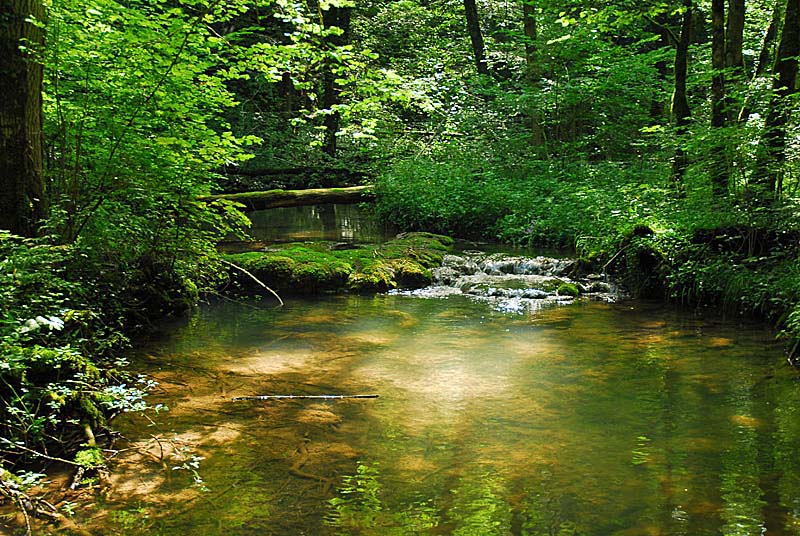
Val Clavin is one of the most prestigious sites in Haute-Marne. It is highly representative of the Montagne Chatillonnaise. Open to the north, the combe has one of the coldest microclimates in the area, favoring vegetation with mountainous tendencies, with forest types closely related to the orientation of the slope: located in the coldest areas, the cold beech-tooth forest and the maple-sedge maple grove develop; on a large proportion of the well-exposed slopes, the montane dry beech forest with Carex alba thrives, with numerous rare and protected species (Cephalanthera rubra and longifolia); hygrophilous forests line the stream and marsh.
Undeveloped site (stay on the marked hiking trail)
Access reserved for an informed and respectful public
For nature specialists:
Today's grasslands cover a tiny area compared with their extent 50 years ago: they are groupings belonging to the Violo rupestris-Seslerietum (well endowed with rare and protected species such as great gentian, bird's-foot sedge and rock violet) and the Festuco lemanii-Brometum (with bird's-foot sedge and whitish helianthemum, protected in Champagne-Ardenne).
Vegetation :
The tufa marsh vegetation is one of the most original in the Val, with low marshes criss-crossed by brooks and peat bogs, dominated by choin ferrugineux (a nationally protected species), along with swertie perenne, broad-leaved cotton grass, marsh parnassia and a rare orchid, Dactylorhiza traunsteineri, all of which are on the Champagne-Ardenne red list of plants: the flora of this group is typically mountainous and rich in protected species.
In the wettest areas, we find the sedge marsh. The megaphorbia on the edges of the marshes and willows include two uncommon species: the protected Aconitum napellus and Filipendula vulgaris.
Several areas of Val Clavin offer dynamic mosaic systems with well-developed edges and small clearings, including a xerophilous grouping with dry beech and grassland species.
The overall vegetation of the site contains 14 protected species and 13 species on the red list of plants in Champagne-Ardenne.
Fauna:
The very rich entomofauna includes many rare species, with seven species of dragonfly (including the nationally protected mercury agrion, on the national and European red lists of endangered insects, the great aeschne, the ringed and bidentate cordulégestres, etc.), five species of crickets, and a large number of other species.), five species of song locusts or grasshoppers, and four species of butterfly, including the sanguisorbe peacock butterfly, the little silver-necked butterfly and the bacchante, protected by the Bern Convention, listed in the Red Book of endangered fauna in France and on the Red List of insects in Champagne-Ardenne.
The avifauna is characterized by numerous passerines (skylark, skylark, grey flycatcher, proyer sparrow, babbler warbler, spotted locustelle, the most typical passerine of the Val Clavin marshes, nesting among oak and mulberry trees, etc.).), various woodpeckers and shrikes (green woodpecker, pileated woodpecker, black woodpecker, great spotted woodpecker, red-backed shrike, grey shrike), diurnal raptors that frequent the site in search of food (black and red kites, northern harrier, hobby and kestrel falcons, bee-eater and sparrowhawk) and nocturnal raptors that nest in the area (little owl, barn owl, tawny owl, long-eared owl), as well as a number of species of hunting interest (turtle and collared doves, quail, various thrushes, woodcock, woodpigeon and pigeon) and other regionally rare nesters such as the dipper. Many of them are on the regional red list.<br>Bats are one of the great treasures of Val Clavin, and include the common noctule, which lodges in the woodpecker holes in the dead trees of the Gorgeot valley, the great murine, Daubenton's murine, the moustached murine, the common serotine, the pipistrelle and the red-eared squirrel; the whole area is more of a hunting area for these chiropterans, which find numerous insects.
The ZNIEFF is part of the larger ZNIEFF II "massif forestier et ses abords au sud d'Auberive". The marsh is still in good condition despite serious damage in recent years (afforestation and extension of agriculture), and the site is now protected by an A. The site is now protected by an A.P.B., and management work has been carried out on the Vivey marsh (Val Clavin). This should be continued. In addition, the Combe Sainte-Marie valley is to be the subject of a biological forest reserve.
Undeveloped site (stay on the marked hiking trail)
Access reserved for an informed and respectful public
For nature specialists:
Today's grasslands cover a tiny area compared with their extent 50 years ago: they are groupings belonging to the Violo rupestris-Seslerietum (well endowed with rare and protected species such as great gentian, bird's-foot sedge and rock violet) and the Festuco lemanii-Brometum (with bird's-foot sedge and whitish helianthemum, protected in Champagne-Ardenne).
Vegetation :
The tufa marsh vegetation is one of the most original in the Val, with low marshes criss-crossed by brooks and peat bogs, dominated by choin ferrugineux (a nationally protected species), along with swertie perenne, broad-leaved cotton grass, marsh parnassia and a rare orchid, Dactylorhiza traunsteineri, all of which are on the Champagne-Ardenne red list of plants: the flora of this group is typically mountainous and rich in protected species.
In the wettest areas, we find the sedge marsh. The megaphorbia on the edges of the marshes and willows include two uncommon species: the protected Aconitum napellus and Filipendula vulgaris.
Several areas of Val Clavin offer dynamic mosaic systems with well-developed edges and small clearings, including a xerophilous grouping with dry beech and grassland species.
The overall vegetation of the site contains 14 protected species and 13 species on the red list of plants in Champagne-Ardenne.
Fauna:
The very rich entomofauna includes many rare species, with seven species of dragonfly (including the nationally protected mercury agrion, on the national and European red lists of endangered insects, the great aeschne, the ringed and bidentate cordulégestres, etc.), five species of crickets, and a large number of other species.), five species of song locusts or grasshoppers, and four species of butterfly, including the sanguisorbe peacock butterfly, the little silver-necked butterfly and the bacchante, protected by the Bern Convention, listed in the Red Book of endangered fauna in France and on the Red List of insects in Champagne-Ardenne.
The avifauna is characterized by numerous passerines (skylark, skylark, grey flycatcher, proyer sparrow, babbler warbler, spotted locustelle, the most typical passerine of the Val Clavin marshes, nesting among oak and mulberry trees, etc.).), various woodpeckers and shrikes (green woodpecker, pileated woodpecker, black woodpecker, great spotted woodpecker, red-backed shrike, grey shrike), diurnal raptors that frequent the site in search of food (black and red kites, northern harrier, hobby and kestrel falcons, bee-eater and sparrowhawk) and nocturnal raptors that nest in the area (little owl, barn owl, tawny owl, long-eared owl), as well as a number of species of hunting interest (turtle and collared doves, quail, various thrushes, woodcock, woodpigeon and pigeon) and other regionally rare nesters such as the dipper. Many of them are on the regional red list.<br>Bats are one of the great treasures of Val Clavin, and include the common noctule, which lodges in the woodpecker holes in the dead trees of the Gorgeot valley, the great murine, Daubenton's murine, the moustached murine, the common serotine, the pipistrelle and the red-eared squirrel; the whole area is more of a hunting area for these chiropterans, which find numerous insects.
The ZNIEFF is part of the larger ZNIEFF II "massif forestier et ses abords au sud d'Auberive". The marsh is still in good condition despite serious damage in recent years (afforestation and extension of agriculture), and the site is now protected by an A. The site is now protected by an A.P.B., and management work has been carried out on the Vivey marsh (Val Clavin). This should be continued. In addition, the Combe Sainte-Marie valley is to be the subject of a biological forest reserve.
🏛️ Lieux similaires à proximité